


Driving Personal Growth through Proprietary Lead Generation with WebLeadz.ai
Executive Summary
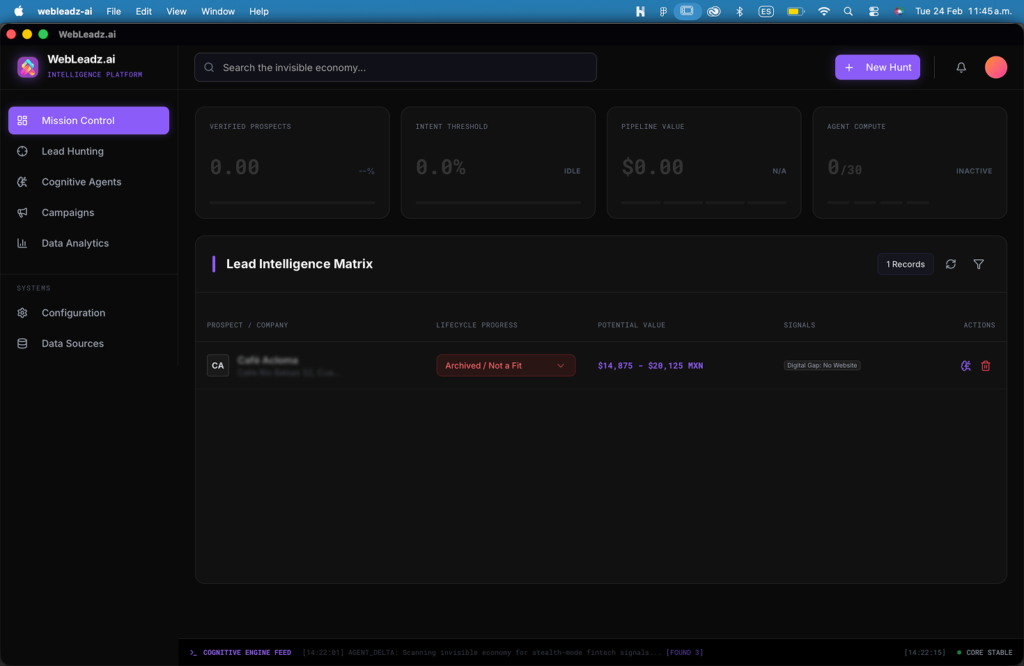
This study provides an in-depth analysis of how WebLeadz.ai, a proprietary native Mac application, revolutionized a personal lead generation workflow by automating local market acquisition.
By harnessing the precise geolocation capabilities of the Google Maps API alongside the advanced linguistic intelligence of Gemini’s natural language processing, the app moved beyond traditional, manual prospecting. The application systematically crawled high-traffic local areas to pinpoint businesses that either lacked a digital presence entirely or suffered from a severely compromised web brand that failed to capture local search intent.
The creation of WebLeadz.ai represents a shift in software development, built through a process of vibe coding where intuition and high-level AI orchestration replaced traditional, rigid coding cycles.
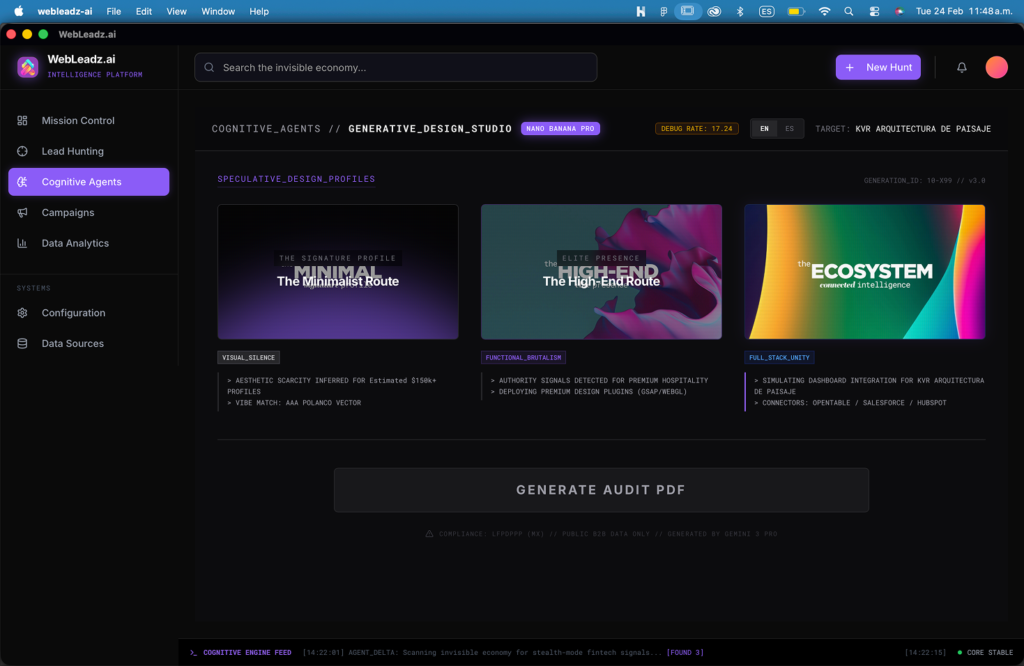
As a Product Designer, I used these tools to bridge the gap between visual concept and functional execution. Once these digitally invisible businesses were identified, the platform’s Gemini-driven engine automatically generated highly personalized, data-driven risk-assessment reports.
These reports translated abstract deficiencies into clear and urgent business consequences. This strategic approach resulted in a remarkable 60-day window during which 12 new premium web development contracts were secured, proving that evidence-based outreach significantly outperforms generic sales pitches.
The Origin: Vibe Coding and Iterative Evolution
WebLeadz.ai did not begin with a massive technical requirements document or a traditional development team. Instead, it was born from vibe coding, a method where the vision for the product drives the implementation through natural language and AI collaboration. This approach allowed me to move from a concept to a functional native Mac app by focusing on the desired experience and logic rather than syntax.
Because the app was developed for personal use as a high-performance lead generator, there was no need to package it for external sale. This private nature is intentional. Vibe coding allows for incredible speed and agility, yet I recognized that the rapid iterations and AI-driven architecture create a unique security profile best managed within a closed, personal environment. By keeping the tool private, I maintain total control over its logic and data handling.
The development process utilized a specialized stack of AI tools to handle everything from design to database architecture:
- LLM Orchestration: The app was built using a combination of Google Gemini 3.0 (lately 3.1) and Claude Sonnet 4.5 (and lately 4.6) models to refine the logic and handle complex coding tasks.
- Research and Logic: Google Gemini’s Deep Search was instrumental in mapping out the geolocation logic and understanding the nuances of the Google Maps API.
- Prototyping: Google Antigravity and Google AI Studio provided the testing grounds for the natural language processing features that drive the risk reports.
- Visual Identity: Photoshop was used in tandem with AI-generated assets to ensure the native Mac interface felt professional and intuitive.
A significant hurdle during development was managing the high volume of requests required for real-time analysis. The initial implementation faced frequent 429 errors with the Gemini API, where rate limits caused the system to stall. Experiments with several model options followed to find a balance between analytical depth and throughput. The breakthrough occurred with the implementation of Gemini 2.5 Flash. This specific model provided the necessary speed and efficiency to handle concurrent business audits without hitting rate limits, effectively solving the waiting time issues and ensuring a smooth user experience.
This development journey is not a finished chapter. The app continues to evolve through daily iterations, with vibe coding allowing me for rapid updates as new business targets and location-based risks are identified.
The Challenge: Manual Inefficiency
The primary obstacle in local business lead generation is the manual effort required to find prospects who actually need assistance. Traditional methods often rely on broad lists that lack context.
Key pain points addressed by the app included:
- Spending hours manually searching Google Maps for businesses without websites.
- The inability to quantify exactly how much revenue a specific business was losing to local competitors with better SEO.
- Lack of personalized hooks to start conversations with business owners beyond generic sales pitches.
- Difficulty in collecting verified contact information for small to medium-sized local enterprises.
The Solution: The WebLeadz.ai Mac App
To address the severe operational bottlenecks of manual prospecting, WebLeadz.ai was integrated as a primary business development engine. This move signaled a fundamental shift from a labor-intensive, fragmented manual searching process. In the past, this work forced a frustrating cycle of juggling dozens of browser tabs, cross-referencing inconsistent Excel spreadsheets, and navigating unreliable business directories.
By operating as a dedicated native Mac application, the software leverages the full processing power of the system hardware, providing a high-performance environment where massive geospatial datasets can be processed locally. This local execution ensures lightning-fast responsiveness and a superior level of data privacy, presented through an interface that mimics professional tools. The app’s unique architecture is built on a synergy between two powerful technological pillars: the real-time data of Google Maps and the sophisticated reasoning capabilities of Gemini’s generative intelligence. This harmony allows the software to offer four critical advantages:
1. Geo-Targeted Business Crawling
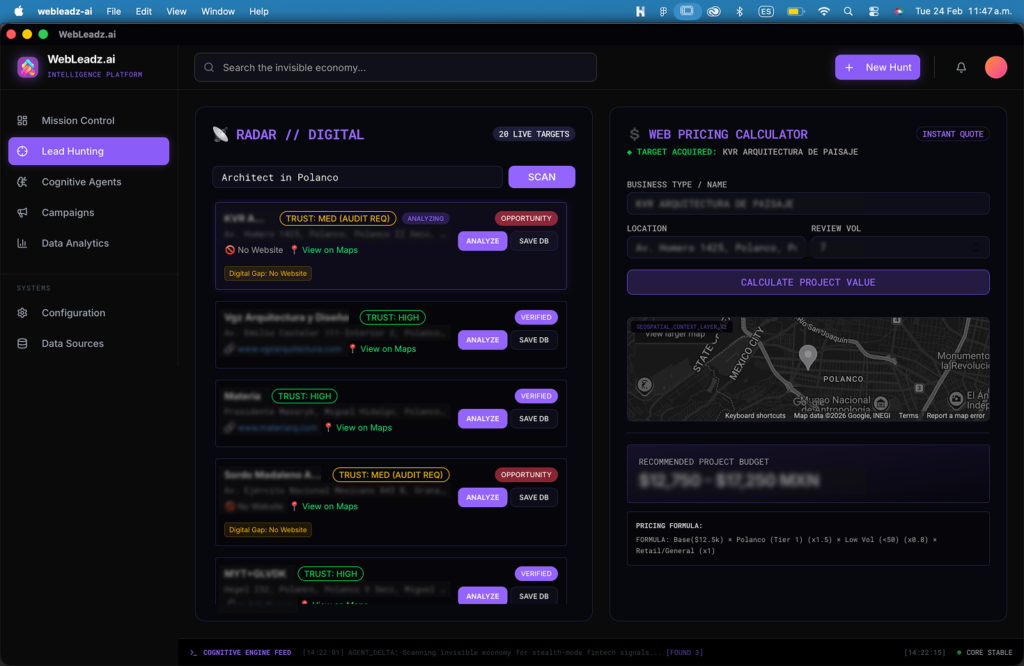
Using the Google Maps API, the app crawled specific geographic coordinates to identify every business within a target niche, such as plumbers in North Austin, a café in Polanco, Mexico City or boutique hotels in Guadalajara. This ensured the lead list was hyper-localized and physically relevant.
2. Automated Web Presence Audit
As the app crawled, it performed a real-time analysis of each brand’s digital footprint. It identified businesses that had no website linked to their Google Business Profile, possessed outdated or non-responsive sites, or lacked basic SEO elements.
3. Gemini-Powered Risk Reporting
Using the Gemini API, WebLeadz.ai translated technical gaps into financial risks. The app generated natural language reports for each prospect, explaining the specific consequences of their weak web presence based on their location. The report would calculate estimated search volume in their zip code and show the percentage of market share captured by competitors.
4. Revenue Leakage Modeling
The app provided a data-backed estimate of lost revenue. By analyzing the foot traffic and search intent in a specific neighborhood, the app exemplified how much money a business was likely losing to competitors who possessed a stronger digital authority.
Strategy and Implementation
The lead generation workflow followed a streamlined three-step process within the native Mac interface:
- Search Parameter Selection: The user entered a target industry and a specific city or neighborhood. The app then initiated a deep crawl of Google Maps data.
- Lead Enrichment: Once the app identified businesses without websites or with high-risk web presences, it automatically collected available contact information.
- The Problem-First Outreach: Instead of a standard pitch, a WebLeadz-generated report was sent. This acted as a diagnostic tool, showing the business owner their specific digital risk score and the financial benefits of fixing their web presence.
Key Results
After two months of utilizing the WebLeadz.ai workflow, the following results were achieved:
- Lead Identification Speed: The time taken to find 50 high-quality, local prospects dropped from 15 hours to 10 minutes.
- Conversion Rate: The response rate to cold outreach increased by 250% because the initial contact was built around a personalized risk report.
- Contract Value: Because the reports could prove revenue leakage, it was possible to justify higher pricing for web development and SEO packages.
- Pipeline Accuracy: 100% of the effort was focused on the digital gap market identified by the app.
Conclusion
WebLeadz.ai has transformed the way I engage with the local business community. By combining the vast data of Google Maps with the analytical power of the Gemini API, the app moves beyond simple lead listing and enters the territory of strategic consultancy. It provides the reasons and the financial context behind a business’s need for a website, making the sales process a matter of fixing a documented problem rather than selling an abstract service.
For me, WebLeadz.ai is a dedicated lead generation assistant that works natively on the desktop to find and help me close the businesses that need digital transformation the most. The app’s ability to turn local data into a compelling narrative of financial risk ensures that every outreach attempt is backed by evidence, leading to faster closes and stronger business partnerships.




No comment yet, add your voice below!